Google Intrisinc Robotics OS Ecosystem
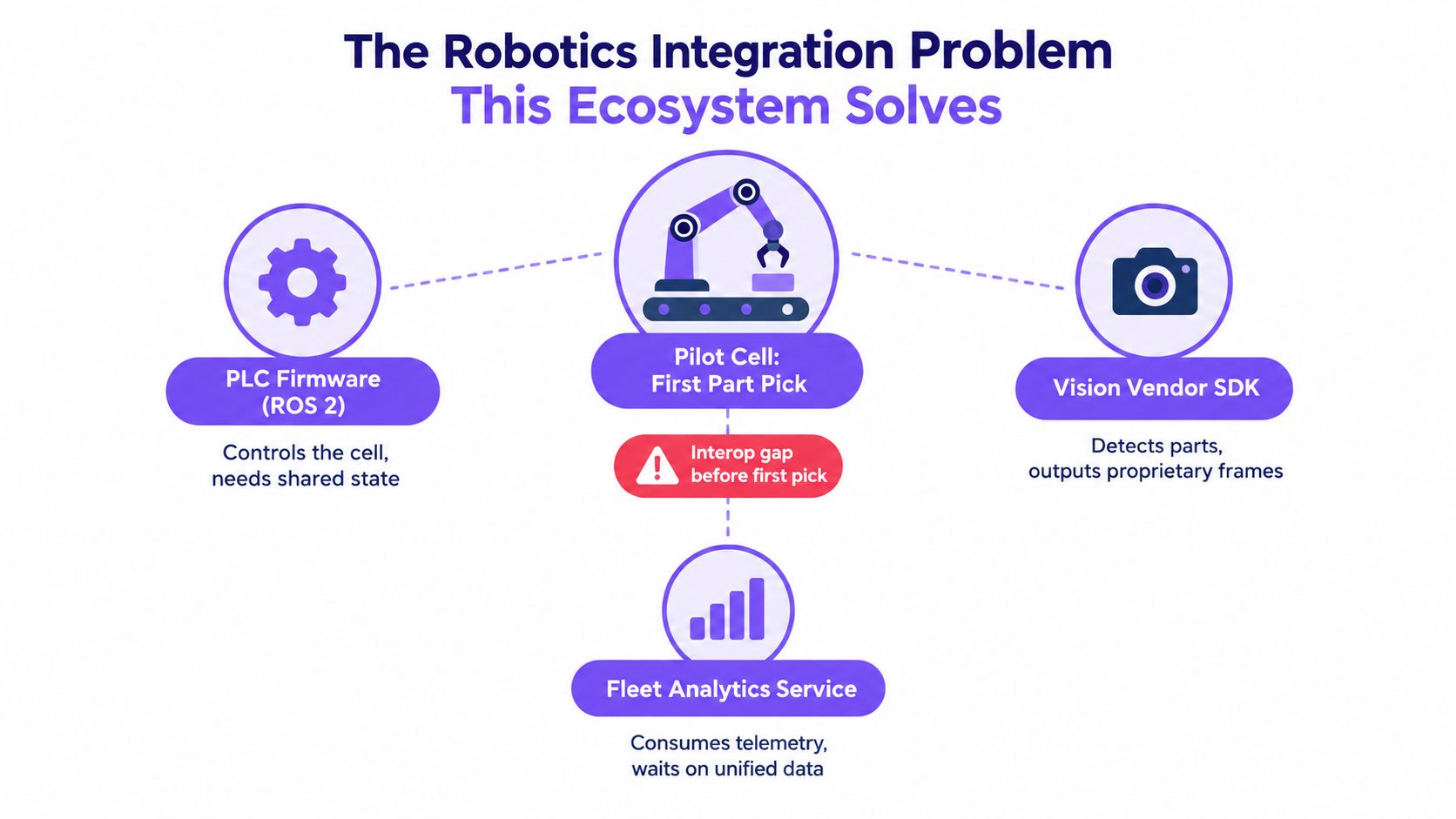
You're standing beside a pilot cell that should be simple to demonstrate. A robot arm waits for a pick command, the PLC reports that the station is ready, a vision camera sees the part, and a fleet dashboard is supposed to record what happened. Instead, the ROS 2 node publishes state that the vendor SDK can't consume cleanly, the analytics service has a separate identity model, and the recorded video becomes another isolated file that someone must scrub manually after a failure.
That is the practical problem behind the Google Intrinsic Robotics OS Ecosystem. Intrinsic isn't just another robot application or a new arm controller. Its public architecture points toward a software layer that connects industrial hardware, robot capabilities, simulation, cloud services, and operational data. The interesting question for developers isn't whether the “Android for robots” analogy sounds appealing. It's how much of an existing stack can be retained, what belongs on the industrial PC, and where a multimodal memory layer can make physical AI systems easier to operate.
Table of Contents
- The Robotics Integration Problem This Ecosystem Solves
- The boundary problem matters more than the robot brand
- Inside the IntrinsicOS and Intrinsic Core Stack
- What runs at the edge
- What belongs in the service layer
- How Intrinsic Compares to ROS 2 and Other Robot Middlewares
- The migration friction is concrete
- Multimodal Query Patterns for Video, Audio, and Sensor Streams
- Three useful query patterns
- Industry Use Cases from Dashcams to Surveillance and Robotics Vision
- Search changes the workflow in each setting
- SDK Integration Patterns for Kotlin, Flutter, and Edge Linux
- Edge Linux needs stronger failure handling
- Developer Pain Points the Search Layer for Physical AI Fixes
- What changes for the engineering team
- Mobile Stacks from Smart Glasses to Dashcams and CCTV
- Best Practices for Edge Robotics Deployment
- A practical deployment checklist
- Quick Reference Matrix for the Google Intrinsic Ecosystem
The Robotics Integration Problem This Ecosystem Solves
A first pilot pick usually fails before the robot moves. The PLC has a station-state machine, the vision supplier exposes a proprietary frame format, and the fleet analytics platform expects telemetry through a web service. Each component works in isolation. The cell becomes fragile at the boundaries.
ROS 2 can provide a strong communication foundation, but it doesn't automatically reconcile every transport, lifecycle, identity, or data-model decision made by a vendor SDK and a cloud service. A vision node may publish detections through ROS topics while the analytics platform expects REST or gRPC. The PLC may expose a different notion of readiness from the robot controller. Meanwhile, camera footage, microphone input, force data, and event logs live in separate pipelines.
Intrinsic was launched by Alphabet on July 23, 2021, after more than five years of incubation inside Google X, marking its move from moonshot research into an independent Alphabet business focused on industrial robotics software, as CNBC reported at the time. That origin helps explain the company's emphasis on an operating layer, interoperability, cloud services, real-time control, and deployment on industrial PCs connected to robots, PLCs, and factory IT systems.
The boundary problem matters more than the robot brand
A useful integration substrate should give developers a consistent place to define:
- Physical state, including robot position, gripper status, sensor readings, and PLC conditions.
- Capabilities, such as grasping, motion planning, calibration, and perception.
- Deployment state, including which software version is running in a cell.
- Operational evidence, including video, audio, telemetry, and failure context.
- Identity and policy, so a cell can authenticate to the services it requires.
Intrinsic's public description of IntrinsicOS follows this direction. The same software stack is intended to work in simulation and on real hardware, while containerized applications run on a Linux-based system connected to industrial equipment. The architecture also includes industrial interfaces such as OPC UA for connecting robots, PLCs, and manufacturing execution systems, as described in Intrinsic's technical specifications.
That doesn't remove integration work. It changes where the work happens. Instead of writing another one-off bridge for every cell, the team can decide which state and capability contracts belong in the robotics runtime, which services should remain remote, and how recorded operational context should be made useful to engineers.
Practical rule: Treat the pilot cell as a distributed software product, not as a robot with accessories. The integration contract should be designed before the first part is picked.
The ecosystem is most valuable when it turns these contracts into reusable assets. It's less useful when a team assumes that a platform layer will magically absorb undocumented PLC behavior, unsafe vendor abstractions, or unvalidated perception models.
Inside the IntrinsicOS and Intrinsic Core Stack
The cleanest way to understand Intrinsic is to separate the runtime layer from the capability layer. IntrinsicOS is the part closest to the machine. Intrinsic Core is the open foundation for assembling robotics capabilities and connecting them with Intrinsic's broader services.
IntrinsicOS is a Linux distribution adapted for interaction with robot controllers. A customer runs a Solution on an industrial PC connected to robot hardware, and the same software stack is designed to operate virtually or on real hardware. Intrinsic says the runtime can execute containerized applications securely and reliably in production, while cloud services support authentication, encryption, machine-learning pipelines, and data management. The edge placement is important because motion-control I/O and sensor handling shouldn't depend on a round trip to a remote service.
Intrinsic Core, announced as an open-source foundation in 2026, is ROS-compatible and licensed under Apache 2.0. It includes control, motion planning, grasp planning, simulation, pose estimation, and camera calibration capabilities, according to Forbes' coverage of the release. Intrinsic's own Intrinsic Core documentation also describes hardware-agnostic real-time control, asset models, a native digital twin, and drivers for third-party sensors and grippers.
What runs at the edge
Keep the IPC responsible for actions that must remain available when the factory network is degraded:
- Controller interaction and motion execution.
- Local sensor processing and safety-related gating.
- Robot, gripper, camera, and PLC connectivity.
- Runtime state needed to continue or safely stop a task.
- Local simulation or validation steps required before execution.
The precise authority boundary still needs to be agreed with the safety team and equipment suppliers. IntrinsicOS can provide the software environment, but it doesn't replace a machine's certified safety architecture or a careful risk assessment.
What belongs in the service layer
Use cloud-connected services for functions that benefit from shared infrastructure rather than immediate control:
- Authentication and encryption.
- Model and application lifecycle management.
- Fleet-level data management.
- Shared development and simulation workflows.
- Historical analysis across cells.
Intrinsic's ecosystem story describes a cloud and edge combination, not a cloud-only robot. That distinction is central to a production design. If a feature can wait, centralize it. If losing connectivity could create an unsafe or unpredictable machine state, keep the necessary logic local.
| Layer | IntrinsicOS, Edge Runtime | Intrinsic Core, Open Capability Foundation |
|---|---|---|
| Primary role | Runs a Solution on an industrial PC connected to robot hardware | Provides reusable robotics capabilities and ROS-compatible building blocks |
| Typical responsibilities | Local execution, hardware interaction, containerized applications, industrial interfaces | Control, motion planning, grasp planning, simulation, pose estimation, calibration |
| Hardware relationship | Sits close to controllers, sensors, robots, PLCs, and factory systems | Supplies reusable components that can work with heterogeneous hardware |
| Cloud relationship | Uses cloud services for identity, encryption, machine-learning pipelines, and data management | Works with Intrinsic enterprise services while supporting local robotics development |
| Best extension point | Runtime adapters, device integration, local operational policies | Skills, capability composition, simulation assets, and reusable application logic |
The practical decision is straightforward. Extend IntrinsicOS when the feature is about making a particular cell run correctly. Extend or compose Intrinsic Core when the feature is a reusable robotics capability that should travel across cells and hardware configurations.
How Intrinsic Compares to ROS 2 and Other Robot Middlewares
Intrinsic shouldn't be evaluated as a universal replacement for every robotics middleware. ROS 2, YARP, and OROCOS solve adjacent problems with different priorities, and many production teams will keep more than one layer.
ROS 2 remains attractive when a team needs broad community adoption, mature message-passing patterns, and access to a large range of packages. Its DDS-based publish and subscribe model is particularly useful when many independent nodes need to exchange data without a central application owning every connection. That breadth is a real advantage, especially for mobile robots, research platforms, custom sensors, and teams that already have tested ROS 2 pipelines.
Intrinsic's advantage is more operational. Its industrial-PC-first architecture, robot-oriented capability model, and connection to managed services can reduce the glue code needed to turn a manipulation workflow into a deployable cell application. The open-source release of Intrinsic Core under Apache 2.0 also lowers the barrier for teams that want to inspect, adapt, and integrate foundational components, as SiliconANGLE reported.
The migration friction is concrete
A ROS 2 system doesn't become an Intrinsic system because both sides use the word “compatible.” Teams still need to map:
- DDS topics and quality-of-service settings to the target capability interfaces.
- ROS 2 lifecycle nodes to the deployment and activation model used by a Solution.
- Existing
ros2_controlhardware interfaces to Intrinsic's skill and asset abstractions. - Custom safety wrappers to the authority boundary between the IPC and certified safety hardware.
- Bag files, simulation assets, and calibration data to the new development workflow.
YARP can be a good fit where modular device communication and research-oriented interoperability are central. OROCOS is compelling when a team prioritizes real-time control components and has the engineering discipline to assemble the surrounding application infrastructure. Vendor-specific stacks may offer a polished path for a narrow robot family, but they can become restrictive when a cell combines different controllers, cameras, grippers, and analytics systems.
| Middleware | Real-Time Control | Simulation and Tooling | Ecosystem Breadth | Industrial Fit |
|---|---|---|---|---|
| Intrinsic Core with IntrinsicOS | Designed for local industrial-PC execution and reusable control capabilities | Intrinsic simulation, digital-twin, and sim-to-real workflow | Strong focus on industrial manipulation and interoperable capabilities | Strong when managed deployment and heterogeneous cell integration matter |
| ROS 2 | Depends on the selected nodes, executors, controllers, and system design | Broad tooling, including Gazebo and other ROS-compatible simulation workflows | Very broad across research, mobile robotics, sensors, and manipulation | Strong, but integration governance remains the team's responsibility |
| YARP | Modular, with real-time behavior depending on components and deployment | Often assembled from project-specific tools | Useful for modular research and device communication | Suitable where flexible middleware composition is a priority |
| OROCOS | Strong orientation toward real-time control components | Requires surrounding tools and project integration | More specialized than ROS 2 | Suitable for teams with deep control and systems expertise |
| Vendor middleware | Often optimized for one supplier's hardware | Usually polished for that hardware family | Narrower outside the vendor ecosystem | Efficient for standardized fleets, less flexible for mixed cells |
The best migration strategy is incremental. Preserve validated ROS 2 nodes where they provide clear value, place an explicit compatibility boundary around them, and move one capability at a time. Replacing a stable controller interface only to achieve architectural uniformity creates risk without creating much operational benefit.
Multimodal Query Patterns for Video, Audio, and Sensor Streams
A robotics search layer should be treated as an operational interface, not as a second motion controller. Its job is to help a person or agent retrieve relevant moments from physical activity, then connect those moments to the state of the machine.
A developer may need to ask for a video segment showing a gripper losing contact with a part, find footage visually similar to a known failure frame, or locate audio that coincided with a change in motor behavior. Multimodal systems are designed for this combination of text, video, audio, and action data. NVIDIA's explanation of omni-models describes how unified multimodal architectures can support robotics-style workloads, cross-modal retrieval, RAG, and agent workflows.
The request shape should stay intentionally simple at the application boundary. A client supplies an intent, a time range or device scope, and the media or event context needed to interpret the request. The response should return references to relevant time segments, modality labels, and enough context for the caller to open the evidence or pass it to an operator.
Three useful query patterns
Text to video works for questions such as “show failed picks involving reflective packaging.” Natural language is useful when operators don't know camera names, event codes, or exact timestamps. V-Modal's overview of video and audio search describes the practical value of connecting visual frames with contextual signals and retrieving precise time segments instead of relying only on manual tags.
Image to video starts with a reference frame, such as a successful or failed grasp, and retrieves visually similar moments from neighboring camera segments or historical trials. This is valuable during regression analysis, where the engineer has one known failure but doesn't yet know which attributes describe it reliably.
Voice to audio and event search links spoken descriptions or sound events to timecoded evidence. A useful system should account for environmental sounds, not only speech. The same source notes that an abnormal mechanical sound can be matched to a visual timeline, which gives an engineer a way to investigate what the robot was doing when the sound occurred.
Sensor telemetry should be treated as contextual evidence. Joint state, force-torque readings, encoder values, and IMU data can help distinguish a visual near miss from an actual contact event. The implementation details should remain behind a stable retrieval contract, so application developers aren't forced to build separate analysis pipelines for every modality.
Industry Use Cases from Dashcams to Surveillance and Robotics Vision
Multimodal search earns its place when it removes a specific review bottleneck. Dashcam investigators, CCTV operators, video editors, and robotics engineers all ask for matching moments, yet each environment stores different evidence and imposes different retention and latency constraints. The deployment decision is therefore practical: keep time-sensitive detection and indexing near the source, while sending selected evidence or broader historical analysis to the cloud.
A dashcam operator can search for “the car that ran the red light” and open the relevant incident without scrubbing through hours of recordings. Dashcam search examples describe natural-language retrieval for incidents, vehicles, and maneuvers. In a fleet, “near-miss events at intersections during rain” combines scene content, movement, and weather context. The result must retain the event window and originating vehicle, or an investigator cannot verify what happened. A practical design runs initial detection on the vehicle or nearby gateway, then uploads matched clips and metadata for fleet-level review.
CCTV creates a similar retrieval problem across many cameras. Operators may search for a person by appearance, direction of travel, or behavior. Converting detections into searchable metadata and timestamps reduces the need to maintain a separate rule for every camera. Queries can cover attributes such as color and shape, along with movement and behavior. Production systems still require operator verification, retention controls, access logging, and explicit policies for sensitive searches. Those controls belong beside the search service, not after it.
Search changes the workflow in each setting
| Industry | Query Example | Modalities | Deployment |
|---|---|---|---|
| Dashcam fleets | “Find intersection near misses during rain” | Video, audio, location, vehicle telemetry | Local recording with selective upload and fleet-level review |
| CCTV and video surveillance | “Find a person moving toward the east exit with a red backpack” | Video, timestamps, object attributes, behavior | Edge gateway or NVR-assisted search with operator verification |
| Advertisement video editing | “Find shots matching this product frame with clean front-facing composition” | Reference image, video, dialogue, ambient audio | Cloud-assisted media library search for editors |
| Robotics vision | “Find trials where the gripper slips on glossy plastic” | Video, robot state, gripper data, force, audio | Cell-local evidence capture with broader historical analysis |
| Audio for robotics | “Find the pick cycles with a scraping sound” | Environmental audio, video, motion state | Edge event detection with linked visual review |
Advertisement video editing illustrates the same retrieval principle outside robotics. Editors can search a media library for shots resembling a reference product frame, then inspect the surrounding timeline. Search reduces dependence on filenames and manually maintained tags.
For robotics, the strongest use is often operational memory. Engineers can search teleoperation recordings, compare successful and failed trials, and connect a visible error with robot state and environmental audio. The IPC should capture and index evidence required for immediate diagnosis, while cloud systems can support broader historical comparison. That separation keeps the cell responsive without abandoning long-term analysis.
The result can guide a new skill, a calibration change, or a revised workcell procedure. It should inform control changes, not make them automatically. This boundary is where multimodal search supports a robotics stack without becoming the safety-critical controller.
SDK Integration Patterns for Kotlin, Flutter, and Edge Linux
The client surface should match the device. A phone, a smart-glasses companion, and an industrial PC have different power, connectivity, storage, and lifecycle constraints. A single retrieval contract can still serve them, but the upload and retry behavior shouldn't be identical.
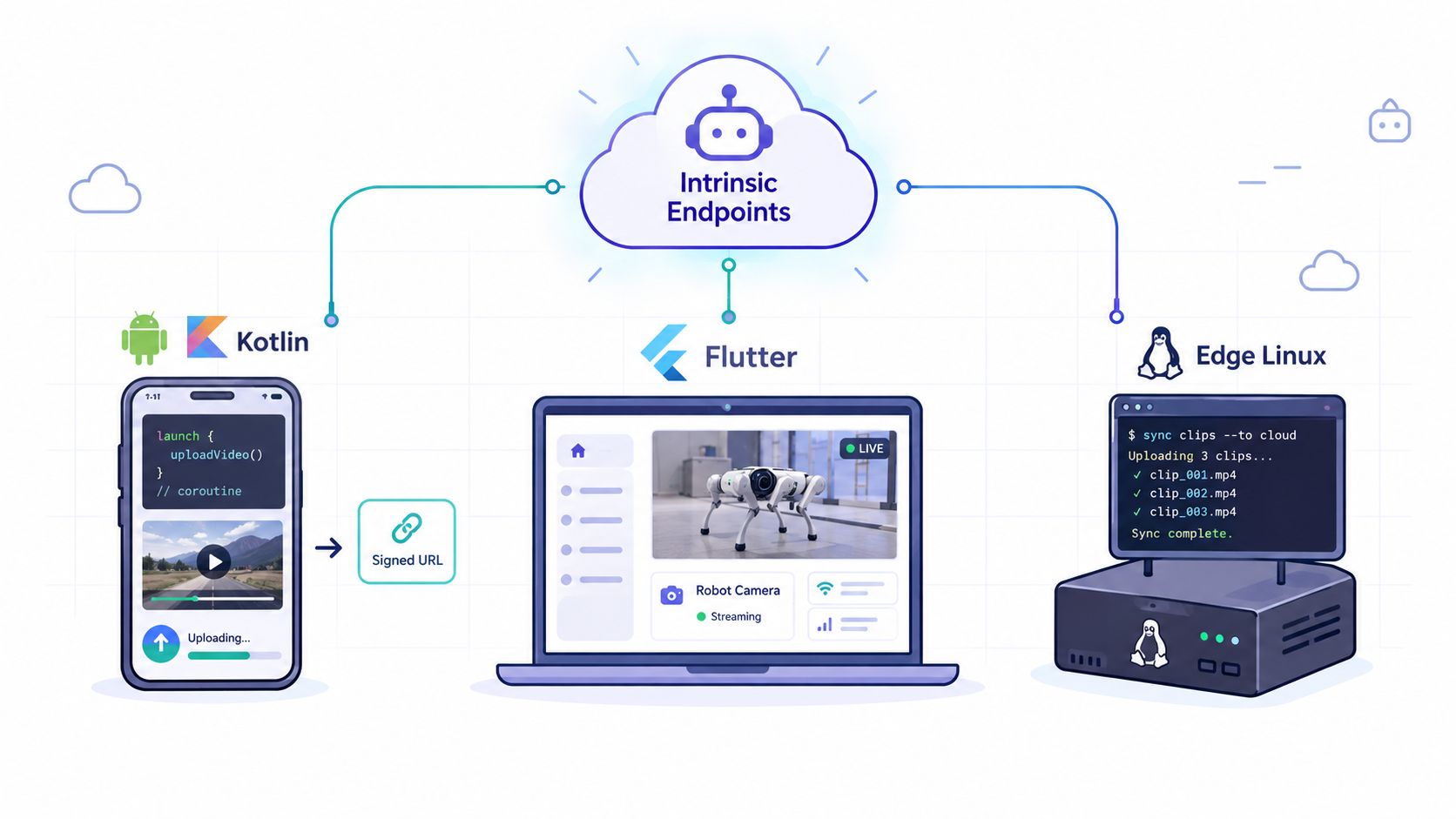
For Android Kotlin, use a foreground or long-lived service for recorded media work, keep authentication and upload state outside the activity lifecycle, and expose results through a coroutine-friendly stream. The independent review of V-Modal's mobile and robotics SDKs describes platform-specific SDKs for Flutter and Android Kotlin, along with robotics applications and API-oriented multimodal indexing.
Flutter works well as a shared application layer when the same search experience needs to run across mobile devices. Keep hardware-specific media handling behind platform channels, especially for camera, microphone, codec, and background-upload behavior. Dart-side retry logic should distinguish an expired authorization context from a transient network failure, because blindly retrying both can create duplicate work or confusing user states.
Edge Linux needs stronger failure handling
An industrial PC or robotics edge computer should assume that connectivity will be intermittent. Use a local queue for media and event references, resume interrupted transfers, and associate every ingest operation with a stable application-level identity. A signed streaming URL can keep large media outside the application process, while chunked multipart transfer is appropriate when a local recorder must send a long teleoperation session in pieces.
The important integration patterns are shared across clients:
- Cache tokens carefully: Refresh authentication without interrupting an active recording or search request.
- Make requests repeatable: Use an idempotency key or equivalent operation identifier so a retry doesn't create a second logical ingest.
- Resume partial work: Record completed segments locally and restart from the first missing segment.
- Separate evidence from control: A failed upload shouldn't block a safety stop or local robot state transition.
- Keep the response contract stable: Mobile UI, edge agents, and engineering dashboards should consume the same result concepts even when their transport differs.
The robotics platform should own machine execution. The multimodal client should own evidence capture and retrieval. Keeping those responsibilities separate makes failures easier to diagnose and prevents a search service from becoming an unreviewed dependency in a motion path.
Developer Pain Points the Search Layer for Physical AI Fixes
Physical AI systems generate useful evidence continuously, but developers often can't retrieve it when they need it. A camera archive, audio track, force signal, and robot state log may all exist, yet the incident review still begins with a person guessing which file to open.
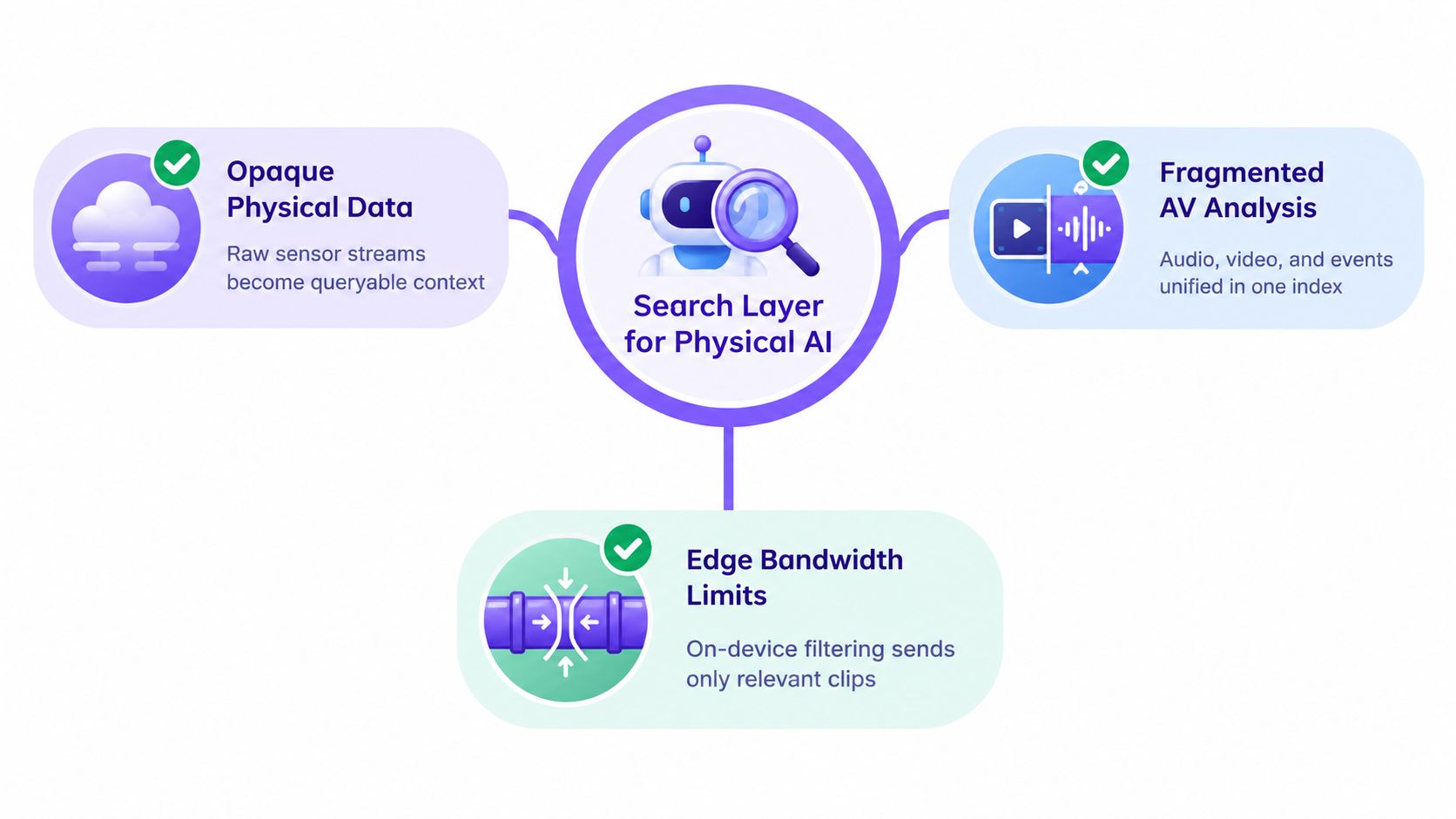
The first pain point is opaque physical data. Natural-language and visual retrieval can turn raw operational history into queryable context, provided the result points back to the original time segment and device. That changes debugging from “find the right recording” to “review the evidence associated with this physical event.”
The second is fragmented audio-visual analysis. A vision pipeline may identify a contact event while an audio pipeline identifies a scrape, but separate outputs leave the engineer to reconcile timestamps and confidence manually. A multimodal search layer can expose a single retrieval contract across video, audio, image, and environmental streams. That doesn't guarantee correct interpretation. It does provide a more coherent starting point for review.
What changes for the engineering team
- Root-cause review becomes evidence-led: Engineers can start with a physical description, then inspect linked clips and sensor context.
- Fusion scripts become less disposable: A shared query surface reduces the need to create a one-off join for every incident type.
- Edge deployments can filter earlier: Local processing can identify relevant events before a system sends every raw stream upstream.
- Agents get grounded context: A downstream diagnostic or operations agent can receive retrieved moments instead of an unstructured archive.
- Media becomes part of the asset history: A workcell's record can include what happened, not only whether a task returned success or failure.
The trade-off is governance. Searchable physical history needs retention rules, access controls, provenance, and a clear distinction between an automated match and a confirmed incident. A search layer helps teams find evidence, but it doesn't remove the need for calibration, validation, or human judgment in safety-sensitive workflows.
Mobile Stacks from Smart Glasses to Dashcams and CCTV
Mobile and distributed cameras don't all need the same architecture. A pair of smart glasses has a constrained battery and a human wearer. A GoPro-style camera may record offline for a long session. A dashcam continuously captures driving context, while CCTV often relies on fixed cameras connected to an edge recorder.
Smart glasses should prioritize event-triggered capture and lightweight local processing. The device or its companion phone can retain the immediate context, then forward selected clips or compact representations when connectivity allows. That supports a hands-free workflow without treating the glasses as a full industrial computer.
Dashcams need durable local recording and a clear incident-window policy. Uploading every raw frame is often a poor operational choice, especially when the fleet needs only relevant segments for investigation. The query contract should preserve vehicle identity, time, location, and the relationship between the incident window and the surrounding footage.
GoPro-style devices benefit from an offline-first companion application. The app can maintain a transfer queue, use resumable uploads, and avoid forcing the user to keep the camera connected throughout a large media transfer. The same design applies to teleoperation recordings captured away from a reliable factory network.
| Device Class | Primary Pattern | Upload Strategy |
|---|---|---|
| Smart glasses | Companion-assisted event capture and contextual search | Send triggered clips or selected representations when the link is available |
| Dashcam | Continuous local recording with incident retrieval | Upload incident windows and selected fleet-search context |
| GoPro-style camera | Offline capture with companion-app transfer | Use queued, resumable multipart uploads |
| CCTV | Fixed-camera monitoring through an edge recorder | Search locally where possible, then forward relevant evidence |
| Mobile app | User-driven search and review | Fetch media references and return results through a cross-platform client |
CCTV deployments usually need an edge NVR or gateway that can handle many camera streams without forcing every query through a remote service. Mobile apps and smart-glasses companions need a smaller footprint, simpler lifecycle handling, and graceful behavior when the network disappears.
The common contract is more important than the device-specific transport. A user should be able to ask for an event, receive time-bounded results, and open the originating evidence whether the request came from a phone, a control-room console, or a robotics engineering tool.
Best Practices for Edge Robotics Deployment
Start by treating the industrial PC as the boundary of machine authority. Perception needed for immediate action, controller interaction, state validation, and safety-related decisions should remain local. Model training, fleet analytics, long-horizon planning, and cross-cell reporting can use cloud services without placing the robot's basic behavior behind a network dependency.
Partition workloads by consequence rather than by fashionable architecture. A motion decision that must respond immediately belongs beside the controller. A perception result that can tolerate additional processing may combine local evidence with a remote service. Historical search and fleet comparison are asynchronous by nature.
A practical deployment checklist
- Build the cell in simulation first: Reuse asset definitions, calibration information, and workflow logic where possible, then validate against recorded cell behavior before promotion.
- Keep local memory bounded: Use ring buffers for sensor history and explicit eviction policies for media references and cached representations.
- Version every artifact: Track the application, model, calibration, index, and policy that produced an operational result.
- Design rollback before rollout: A signed, reversible deployment pointer is more useful than an elaborate release process that can't restore the prior state.
- Test degraded connectivity: Verify that the cell can pause, stop, or continue safely when cloud services are unavailable.
- Separate safety evidence from search convenience: A retrieved clip can support an investigation, but it shouldn't become the authority for a motion decision without clear justification.
Intrinsic's public materials emphasize operation from simulation to real hardware with the same software stack, while Intrinsic Core adds simulation, calibration, and reusable control components. The practical benefit depends on disciplined asset management. A simulation that omits sensor noise, lighting changes, gripper variance, or network interruptions won't prepare a cell for those conditions.
Quick Reference Matrix for the Google Intrinsic Ecosystem
Use this matrix as a design aid when assigning ownership between local runtime, open capability components, cloud services, and client applications.
| Stack Layer | Deployment Target | Primary API or Surface | Typical Use Case |
|---|---|---|---|
| IntrinsicOS runtime | Industrial PC beside the cell | Solution runtime and hardware interfaces | Local robot, PLC, sensor, and containerized application execution |
| Intrinsic Core | Development environment and connected robotics deployments | ROS-compatible control, planning, simulation, calibration, and asset capabilities | Reusable manipulation and perception workflows |
| ROS 2 compatibility boundary | Existing ROS 2 nodes and the Intrinsic environment | Topic, lifecycle, hardware, and capability adapters | Gradual migration of validated pipelines |
| Multimodal search layer | Edge hardware and connected services | Text, image, voice, video, audio, and sensor-context retrieval | Finding physical events in operational history |
| Kotlin and Flutter clients | Android devices and cross-platform mobile apps | Native and wrapper SDK surfaces | Smart-glasses companions, field review, and mobile search |
| Edge Linux clients | Industrial PCs and robotics edge computers | Local capture, queued transfer, and service integration | Teleoperation archives, cell evidence, and offline-tolerant workflows |
| Sim-to-real pipeline | Simulation systems and pilot cells | Digital-twin, calibration, validation, and deployment workflow | Promoting tested skills into controlled production cells |
V-Modal AI offers a multimodal video and audio search API, robotics edge memory capabilities, natural-language and visual retrieval, and SDK surfaces for Kotlin, Flutter, smart glasses, and edge-connected systems. If you're evaluating how a search layer can complement an Intrinsic-style robotics stack, review the public V-Modal AI repository and test it against the video, audio, and sensor evidence your pilot cell already produces.